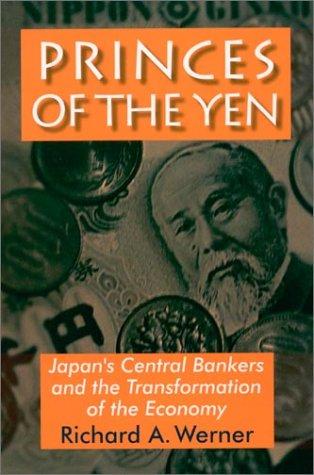
Princes of the Yen: Japan’s Central Bankers and the Transformation of the Economy
Reading Notes
Princes of the Yen: Japan's Central Bankers and the Transformation of the Economy (2003) argues that the Bank of Japan deliberately engineered Japan's post-war miracle, the 1980s bubble, and the subsequent lost decade — all in service of a long-running structural reform agenda pursued by a small cadre of elite BOJ careerists (the "princes").
Core thesis
Monetary policy as conventionally understood (interest rates, money supply targeting) is a smokescreen. The real lever is credit creation — specifically who gets credit, for what purpose, in what quantity. Whoever controls credit allocation controls the economy's structure. In Japan, that control sat with the BOJ, wielded through an informal but binding tool: window guidance (madoguchi shidō).
Structural arc of the book
1. The wartime economic system as template Werner traces Japan's post-war institutions back to the wartime planned economy. The same bureaucratic machinery — credit rationing, administrative guidance, keiretsu-style coordination — was repurposed for reconstruction. BOJ governors like Hisato Ichimada ("the Pope") personify the continuity.
2. The miracle (1945–1970s) High growth wasn't driven by savings, culture, or MITI industrial policy alone. It was driven by BOJ-directed credit creation channelled into productive (GDP-generating) investment — manufacturing, exports, infrastructure. Window guidance told each major bank exactly how much to lend and to which sectors, quarter by quarter.
3. Engineering the bubble (1985–1989) Werner's most provocative claim: the bubble wasn't a policy mistake, it was policy. After the Plaza Accord, the BOJ instructed banks to expand lending far beyond what productive demand justified. The excess credit was pushed into real estate and equities — non-GDP asset transactions — inflating the bubble. Bank managers who resisted were pressured; those who complied were rewarded.
4. Engineering the crash and the lost decade (1990s) The BOJ then deliberately restricted credit creation to burst the bubble, and kept credit restricted through the 1990s despite zero rates and nominal QE. Fiscal stimulus couldn't work because the monetary transmission mechanism was being actively strangled. The purpose: manufacture a crisis severe enough to force structural reform — deregulation, central bank independence, dismantling of the main-bank system, Anglo-American-style capital markets.
5. The political project The "princes" are a hereditary lineage of BOJ elites who inherited a specific ideological agenda: transform Japan from relationship-based, bank-centred capitalism into market-based, shareholder-centred capitalism. Central bank independence (granted in 1998) was the capstone — removing democratic accountability for credit allocation decisions.
Werner's theoretical contribution: Quantity Theory of Credit
The book's analytical spine. Werner disaggregates credit by use:
- **Credit for GDP transactions** → real economic growth, mild CPI inflation
- **Credit for non-GDP (asset) transactions** → asset price inflation, bubbles, eventual banking crises
This resolves the empirical failure of the standard Quantity Theory of Money (MV=PY), which broke down in the 1980s–90s when money supply and nominal GDP decoupled. Werner's answer: measure the right aggregate — credit creation disaggregated by purpose.
Policy implications
- Interest rates are a weak, lagging instrument; credit guidance is the real lever.
- Central bank independence concentrates enormous unaccountable power in a technocratic elite.
- Deregulation of credit allocation (the 1980s financial liberalisation) is what made the bubble possible.
- Recovery from banking crises requires direct credit creation aimed at productive uses, not QE routed through broken banks.
Broader relevance
Werner generalises the Japan case into a template he later applied to the Asian Crisis, the ECB's role in the Eurozone, and 2008. The same pattern — credit expansion into asset markets, engineered crisis, structural reform demanded as the price of rescue — recurs wherever a sufficiently independent central bank has room to operate.
The 2014 documentary of the same name compresses the argument well if you want a visual companion, though the book has considerably more on the institutional history and the BOJ personnel lineage.